Tuesday, September 16, 2014

Red Delicious Apples

The Awful Reign of the Red Delicious

How the worst apple took over the United States, and continues to spread
More
At the supermarket near his home in central Virginia, Tom Burford likes to loiter by the display of Red Delicious. He waits until he spots a store manager. Then he picks up one of the glossy apples and, with a flourish, scrapes his fingernail into the wax: T-O-M.
“We can’t sell that now,” the manager protests.
To which Burford replies, in his soft Piedmont drawl: “That’s my point.”
Burford, who is 79 years old, is disinclined to apple destruction. His ancestors scattered apple seeds in the Blue Ridge foothills as far back as 1713, and he grew up with more than 100 types of trees in his backyard orchard. He is the author ofApples of North America, an encyclopedia of heirloom varieties, and travels the country lecturing on horticulture and nursery design. But his preservationist tendencies stop short of the Red Delicious and what he calls the “ramming down the throats of American consumers this disgusting, red, beautiful fruit.”
His words contain the paradox of the Red Delicious: alluring yet undesirable, the most produced and arguably the least popular apple in the United States. It lurks in desolation. Bumped around the bottom of lunch bags as schoolchildren rummage for chips or shrink-wrapped Rice Krispies treats. Waiting by the last bruised banana in a roadside gas station, the only produce for miles. Left untouched on hospital trays, forlorn in the fruit bowl at hotel breakfast buffets, bereft in nests of gift-basket raffia.
For at least 70 years, the Red Delicious has dominated apple production in the United States. But since the turn of the 21st century, as the market has filled with competitors—the Gala, the Fuji, the Honeycrisp—its lead has been narrowing. Annual output has plunged. And even still, a gap is growing between supply and demand from American consumers. Earlier this month, Todd Fryhover, the president of the Washington Apple Commission—whose growers produce the majority of apples in the United States—recommended that this harvest, up to two-thirds of the state’s Red Delicious yield be exported.
How did such an unlikeable apple become the most ubiquitous in the country? And as its dominion here ends, where will it invade next?
* * *
If you want to make an allegory of the Red Delicious, you might see in it the story of America: confident intrusion on inhabited soil, opportunity won in a contest of merit, success achieved through hard work, integrity pulverized in the machinery of industrial capitalism. In the 1870s, Jesse Hiatt, an Iowa farmer, discovered a mutant seedling in his orchard of Yellow Bellflower trees. He chopped it down, but the next season, it sprang back through the dirt. He chopped it down again. It sprang back again. “If thee must grow,” he told the intrepid sprout, “thee may.”
A decade later, Hiatt’s tree bore its first fruit. The apples were elongated globes with red-and-gold striped skin, crisp flesh, and a five-pointed calyx. In 1893, when Stark Brothers’ Nursery of Louisiana, Missouri, held a contest to find a replacement for the Ben Davis—then the most widely planted apple in the country, strapping and good-looking but bland—Hiatt submitted his new variety, which he called the Hawkeye. “My, that’s delicious,” Clarence Stark, the company’s president, reportedly said after his first bite.
But not for the first time in apple lore, one sweet taste precipitated a fall. Stark Brothers’ soon secured the rights to the Hawkeye, changed its name to the Stark Delicious (only after the branding of the Golden Delicious, in 1914, did it become the Red Delicious), and began an ambitious marketing campaign. Over the next two decades, the nursery spent $750,000 to promote the new apple, dispatching traveling salesmen to farms across the country and exhibiting the Delicious at the 1904 World’s Fair. After the completion of the Great Northern Railway, Clarence Stark sent trainloads of seedlings to newly established orchards in the Columbia River Valley, their leaves trembling as the engines rumbled West.
With its hardy rootstocks and juicy, curvaceous fruit, the Red Delicious quickly became a favorite of growers and consumers from coast to coast—and as its commercial success grew, so did its distance from Hiatt’s Hawkeye. In 1923, a New Jersey orchardist wrote to the Starks to report that one limb of a tree he had purchased from the nursery was producing crimson apples while those on the other limbs remained green. A chance genetic mutation that made the apples redden earlier had also given them a deeper, more uniform color, and customers were lining up for a taste. Paul Stark, one of Clarence’s sons, travelled up from Missouri and laid down $6,000 for the limb. News of the deal spread, and soonThe Gettysburg Times reported that more than 500 horticulturists from 30 states had gathered at the orchard to discuss the “freak bud” that produced “the marvel apple of the age.” Their meeting marked the beginning of an era of fruit improvement, as growers began to seek out and cultivate similar mutations.
By the 1940s, the Red Delicious had become the country’s most popular apple, with the broad shoulders and lipstick shine of a Golden Age Hollywood star. The cosmetic changes were a boon for industrial agriculturalists: Apples that turned rosy before they were fully ripe could be picked earlier and stored longer, and skins with more red pigment tended to be thicker, which extended shelf life and hid bruises. But as genes for beauty were favored over those for taste, the skins grew tough and bitter around mushy, sugar-soaked flesh. Still, by the 1980s, the Red Delicious made up 75 percent of the crop produced in Washington. By the time selective breeding had taken its toll, according to Burford, a few big nurseries controlled the market, planting decisions were made from the remove of boardrooms, and consumers didn’t have many varieties to choose from. The Red Delicious became “the largest compost-maker in the country,” he said, as shoppers routinely bought the apples and threw them away.
Then in the 1990s, new varieties that American growers had originally developed for overseas markets—including the Gala and the Fuji—began to edge into the domestic market. Shoppers had been “eating with their eyes and not their mouths,” Burford said. And now their taste buds had been awakened. A sudden shift in consumer preferences, paired with growing competition from orchards in China, took the industry by surprise. Between 1997 and 2000, U.S. apple growers lost nearly $800 million in surplus crop. They had “made the apples redder and redder, and prettier and prettier, and they just about bred themselves out of existence,” a marketing director for one Northwestern fruit company told The New York Times, shortly after President Bill Clinton approved the largest bailout in the history of the apple industry.
Since then, Red Delicious production has declined by 40 percent. While the apple is still by far the most common in the U.S.—growers produced 54 million bushels of Red Delicious in 2011, compared to just 33 million bushels of its closest competitor, the Gala—the industry is adjusting to a changing market. Todd Fryhover told me that new quality controls like ethylene inhibitors have helped ensure that apples arrive fresh and crisp in the supermarket, but he also acknowledged that tastes have shifted. Exports of Washington’s Red Delicious yield have hovered around 48 percent in recent years. This year, Fryhover recommends that 60 to 65 percent of the apples be shipped abroad. “You can’t keep producing the same thing all the time and ignore what people are asking for,” he told me. American consumers “want Galas, they want Fujis, they want Goldens, Grannies.” International buyers provide demand for the Red Delicious that “currently doesn’t exist in the U.S.”
Beyond North America, the biggest export markets for the Red Delicious are in Southeast Asia. China, which now produces more apples than any other country in the world, has in recent years been a major buyer of Red Delicious from Washington orchards. There, Fryhover points out, the color red symbolizes good fortune. But according to Tom Burford, the international success of the Red Delicious largely relies on targeting shoppers in places where the fruit is unfamiliar. Like Americans just over a decade ago, he said, “they are unaware of what an apple should express.”
In the homeland of the Red Delicious, meanwhile, consumers are slowly returning to apples they can believe in.

Saturday, March 8, 2014

ICE CREAM TRIVIA

Top 3 Ice Cream Consuming Countries in the World

1) United States
2) New Zealand
3) Denmark


Top five U.S. States that produce the most ice cream.

(1) California
(2) Indiana,
(3) Ohio
(4) Illinois
(5) Michigan


The Ice Cream Sundae was invented. Edward Berner of Two Rivers, Wisconsin, supposedly when he served a customer ice cream topped chocolate syrup (used to flavor ice cream sodas). It was a Sunday, and flavored soda water was not served on Sundays to respectable people.

The ice cream cone was invented at the St. Louis World's Fair in 1904. An ice cream vendor ran out of paper cups and asked a nearby waffle booth to make some thin waffles he could roll up to hold the ice cream. However, it is also reported that a patent had been taken out in the late 1890's for an ice cream cone by Italo Marchiony. So, the ice cream cone was probably popularized at the St. Louis Fair, but not invented there.

In 1846, Nancy Johnson invented the hand-cranked ice cream freezer. Nothing more is known about her. Her design was patented in 1848 by William G. Young. Whatever flavor ice cream you like best, you can make it by mixing cream, sugar, and flavorings (like chocolate or strawberry) and then carefully lowering the mixture's temperature until it sets. The discovery of using salt to control the temperature of the ingredients, along with the invention of the wooden bucket freezer with rotary paddles, were major b-r-e-a-k-throughs in the creation of ice cream as we know it. A Baltimore company was the first to sell it to stores in 1851. Finally, with the introduction of refrigerator-freezers came the ice cream shop, which has become a symbol of American culture

What used to be called 'ice milk', is now usually called 'light' or reduced fat' ice cream. It contains from 2% to 7% milkfat, and a minimum of 11% total milk solids.


ICE CREAM HISTORY

The origins of ice cream go way back to the 4th century B.C. When the Roman emperor Nero ordered ice to be brought from the mountains and combined it with fruit toppings. In the 13th century, Marco Polo learned of the Chinese method of creating ice and milk mixtures and brought it back to Europe. Over time, people created recipes for ices, sherbets, and milk ices. It became a fashionable treat in Italy and France, and once imported to the United States, ice cream was served by George Washington, Thomas Jefferson, and Dolley Madison. Jefferson's favorite flavor was vanilla. (Library of Congress)

Once upon a time, hundreds of years ago, Charles I of England hosted a sumptuous state banquet for many of his friends and family. The meal, consisting of many delicacies of the day, had been simply superb but the "coup de grace" was yet to come. After much preparation, the King's French chef had concocted an apparently new dish. It was cold and resembled fresh- fallen snow but was much creamier and sweeter than any other after- dinner dessert. The guests were delighted, as was Charles, who summoned the cook and asked him not to divulge the recipe for his frozen cream. The King wanted the delicacy to be served only at the Royal table and offered the cook 500 pounds a year to keep it that way. Sometime later, however, poor Charles fell into disfavor with his people and was beheaded in 1649. But by that time, the secret of the frozen cream remained a secret no more. The cook, named DeMirco, had not kept his promise. This story is just one of many of the fascinating tales which surround the evolution of our country's most popular dessert, ice cream. It is likely that ice cream was not invented, but rather came to be over years of similar efforts. Indeed, the Roman Emperor Nero Claudius Caesar is said to have sent slaves to the mountains to bring snow and ice to cool and freeze the fruit drinks he was so fond of. Centuries later, the Italian Marco Polo returned from his famous journey to the Far East with a recipe for making water ices resembling modern day sherbets. (International Assn. Of Ice Cream Manufacturers.)


FAVORITE ICE CREAM SHOPS
(Wikipedia, the free encyclopedia)

BASKIN ROBBINS

25% of Baskin Robbins ('31 flavors') ice cream sales are for plain vanilla.
Baskin-Robbins was founded by Burt Baskin and Irv Robbins in 1945 in Glendale, California, and owned by the founders until purchased in 1967 (just prior to Burt Baskin's death) by the United Brands Company (United Fruit), then by the British food company J. Lyons and Co in 1973. 

Baskin-Robbins was known for its "31 flavors" slogan. When the first Baskin-Robbins store opened, they offered 21 flavors, an innovative concept at the time. The idea for 31 Flavors came from Carson-Roberts advertising agency, along with the slogan "Count the Flavors. Where flavor counts." Burt and Irv also believed that people should be able to sample flavors until they found one they wanted to buy -- hence the iconic pink spoon.

Baskin-Robbins most popular flavor was actually created as a gag for a TV show. Comedian Steve Allen introduced the flavor "Steverino" ice cream in a skit on the Steve Allen Show. Always ones to capitalize on an opportunity, Baskin-Robbins began producing Steverino and sold 1,000,000 scoops, an industry record.

Jon Luther, CEO, responding to concerns about the health of their food, "We're going to create a healthy halo over our product line, so if you want coffee with soy milk, you can get it; or a low trans fat muffin, you can get it."

BEN AND JERRY'S

Childhood friends Ben Cohen and Jerry Greenfield took a correspondence course in ice cream-making from Penn State University — Agriculture 5150 — and founded the company in 1978 in a renovated gas station in Burlington, Vermont.

As demand for their products grew, the friends decided to fund their growth by taking the company public. The capital raised from their IPO helped fuel rapid expansion, but also reduced the founders' control.

In 1988, Ben and Jerry were named "U.S. Small Business Persons of the Year" by President Ronald Reagan.

Each year on one day either in late April or early May, Ben and Jerry's observes Free Cone Day, on the anniversary of its opening as a "thank you" to its customers. On this day, over one million cones are given away. The 28th annual Free Cone Day was held on April 25, 2006.

Some of their ice cream flavors are named after musicians, such as their most popular flavor Cherry Garcia, named after Jerry Garcia, and Phish Food, named after the Vermont-based band Phish, as well as Dave Matthews Band's Magic Brownies. Flavors from the company come and go, with seasonal "limited edition" ones appearing each year. Retired flavors enter what is referred to as the "flavor graveyard"]. 2006's new flavors include: Turtle Soup, Vermonty Python, Neapolitan Dynamite, and Black & Tan. Due out late summer will be an apple pie type flavor titled American Pie, which will contain pieces of pie crust.

DAIRY QUEEN

"Sherb's" was the name of a small ice cream store that opened on South West Avenue, in Kankakee, Illinois on August 4, 1938. The proprietor of the store, thirty-year-old Sherwood Dick "Sherb" Noble, had been associated with dairy products from his teen-age years. What his customers were offered that day in Kankakee for 10¢ was a new semi-frozen, "soft serve" dairy product formulated by a recent acquaintance and new business partner, J. F. McCullough. The Dairy Queen companies and franchises recognized Sherb Noble as the "original Dairy Queen operator." 

The first Dairy Queen outlet was opened by Noble in Joliet, Illinois on June 22, 1940. The company's products expanded to include malts and milkshakes in 1949, banana splits in 1951, Dilly Bars in 1955, Mr. Misty slush treats in 1961 (later renamed Misty Slush, then again to Artic Rush), and a range of hamburgers and other cooked foods in the late 1950s, under the Brazier banner. Other popular items include ice cream sundaes and the blended coffee drink, the MooLatte.

A very popular Dairy Queen treat today is the Blizzard, which is ice cream with candy bits blended in; it has been a staple on the menu since 1985. The Blizzard was modeled after the concrete treats of the Midwest.The most popular Blizzard flavors include Oreo Cookies, chocolate chip cookie dough, M&M's, Reese's Peanut Butter Cup, and Butterfinger. Dennis the Menace appeared in Dairy Queen marketing from 1972 until 2002, when he was dropped because Dairy Queen felt children could no longer relate to the character.

During the 1950s and 1960s, Dairy Queens in small towns of the Midwestern and especially Texas, were often a center of social life. In that role they have often come to be referenced as a symbol of life in small-town America, as for instance in Walter Benjamin at the Dairy Queen: Reflections at Sixty and Beyond by Larry McMurtry, Dairy Queen Days by Robert Inman, and Chevrolet Summers, Dairy Queen Nights by Bob Greene. Some of the popular items on the Texas menu include the Hunger-buster and Belt-buster hamburgers. Bob Phillips, host of a popular Texas syndicated television program named Texas Country Reporter was the longtime spokesman for DQ in Texas.

HOWARD JOHNSON'S

Howard Johnson's was founded in 1925 by Howard Deering Johnson when he borrowed $2,000 to buy a small corner drugstore in Wollaston, Massachusetts. It sold candy, newspapers and patent medicine.

After noticing that his soda fountain was the busiest part of his drugstore, Johnson decided to come up with a new ice cream, mostly made in part from his mother's recipe (although some say this is untrue). He eventually came up with 28 flavors and opened a beachfront ice cream stand. According to Johnson, "I thought I had every flavor in the world. The 28 flavors became my trademark."

Over the next few summers he added more beachfront stands, and decided to add hot dogs. His success was beginning to be noticed by others, and thus he was able to convince some bankers to lend him enough money to open a restaurant in Quincy, Massachusetts. This first Howard Johnson's restaurant featured fried clams, baked beans, chicken pot pies, frankfurters, and, of course, ice cream.

In 1932, he persuaded an acquaintance to open another "Howard Johnson's" restaurant in Orleans on Cape Cod under one of the nation's first franchises. Soon there were 17 Howard Johnson's restaurants and by the end of 1936 there were 39 more franchised restaurants. By 1939 there were 107 Howard Johnson's restaurants along East Coast highways generating revenues of $10.5 million.

When the Pennsylvania, Ohio and New Jersey turnpikes were built, Howard Johnson bid on and won exclusive rights to serve the hungry turnpike multitudes. There were 200 Howard Johnson's restaurants by the time of the United States' entry into World War II. Due to war rationing, by the summer of 1944 only 12 remained in business. Mr. Johnson managed to stay barely afloat by serving commissary food to war workers and army recruits. By 1954 there were 400 Howard Johnson's restaurants in 32 states. 

In 1959, the company founder, who still made his headquarters in Wollaston, Massachusetts, turned the reins over to his son, twenty-six year old Howard Brennan Johnson, who succeeded him as president. Howard Deering Johnson died in 1972 at the age of 76.

Saturday, September 7, 2013

Homemade Coffee Creamer – Over 2 Dozen Flavor Varieties!-Recipes

For whatever flavor of creamer you want, you start off with the same basic ‘base’ recipe.

14oz sweetened condensed milk
1 3/4 cup milk or cream (whole, lowfat, skim, almond, soy, heavy cream, half & half etc – whatever your preference, however the more fat, the more creaminess)

Mix the ingredients together well. Add them to a mason jar and shake it like crazy or you could also opt to use an old (washed) creamer container.

French Vanilla Creamer
2 teaspoons vanilla extract OR vanilla coffee syrup

Vanilla Bean Coffee Creamer
2 teaspoons vanilla bean paste

Chocolate
2-3 tablespoons chocolate syrup
(1 tsp vanilla extract, optional)

Chocolate Almond
1 tablespoon cocoa powder
1 teaspoon almond extract

Strudel
1 tablespoon cinnamon
1 teaspoon vanilla extract
1 teaspoon almond extract

Vanilla Caramel
2 tablespoons caramel ice cream topping
2 teaspoons vanilla extract

Chocolate Raspberry
2 teaspoons cocoa powder
2 tablespoons raspberry syrup

Irish Cream
2 tablespoons chocolate syrup
1 teaspoon instant coffee
1-2 teaspoons vanilla extract
1 teaspoon almond extract

Coconut
2 teaspoons coconut extract

Samoa (like the Girl Scout Cookies)
2 teaspoons coconut extract (or sub coconut milk or cream of coconut, heated & strained, for the milk/cream)
2 tablespoons chocolate syrup
2 tablespoons caramel ice cream topping

Peppermint Patty
2 tablespoons chocolate syrup
1 teaspoon peppermint extract

Cinnamon Vanilla
2 teaspoons cinnamon
2 teaspoons vanilla extract

Pumpkin Spice
3 tablespoons pureed pumpkin
1 teaspoon pumpkin pie spice
4 tablespoons maple syrup
1 teaspoon vanilla extract

Honey Vanilla
1/4 cup honey
2 teaspoons vanilla extract

Almond Joy
1-2 teaspoons coconut extract (or sub coconut milk or cream of coconut if you heat it first, strained, in place of the milk & extract)
1 teaspoon almond extract
2 tablespoons chocolate syrup

Sweet Cream
Use 1 3/4 cups of heavy cream instead of the milk in the base recipe
2 teaspoons vanilla extract OR the inside of a vanilla bean, scraped
1 teaspoon almond extract

Chocolate Orange
2 tablespoons chocolate syrup
1-2 teaspoons orange extract

Hazelnut
2 teaspoons hazelnut extract

Chocolate Hazelnut
2 tablespoons chocolate syrup
2 teaspoons hazelnut extract

Cinnamon Cake
2 teaspoons cinnamon
2 teaspoons vanilla extract

Salted Caramel
2-3 tablespoons caramel ice cream topping
1/2 teaspoon salt

Eggnog
replace milk in base recipe with equal amount of heavy cream
1 teaspoons vanilla extract
2 teaspoons rum extract
1 teaspoon ground nutmeg

Toasted Almond
2 teaspoons almond extract

Directions & Tips:
In all these recipes, anything that has a dry or thick ingredient (like cinnamon, honey, etc..) should be heated up with a small amount of your milk/cream from the base recipe so it can dissolve properly. You don’t want grainy creamer! Then, add the rest of the milk/cream along with the sweetened condensed milk.

If you want really creamy creamer, use heavy cream instead of milk in your base recipe.

You'll want to stick a piece of tape on they mason jar lid with the expiration date from the milk used. Use this as a guideline as to when the creamer should be used by.

Please feel free to play around with amounts of extracts and other ingredients used if you like stronger or less intense flavors!! And, let your imagination turn, and make up your own combinations. Use this as inspiration to create your very own perfect homemade flavored creamer!

Wednesday, March 20, 2013

Atomic Gardening: Breeding Plants With Gamma Radiation

Did you know that the peppermint flavor in your chewing gum and toothpaste, and the red-ruby grapefruit on your plate, is the result of mutation caused by deliberate irradiation? Apparently, after World War II, there was a concerted effort to find peaceful uses for atomic energy. One of the ideas was to bombard plants with radiation and produce lots of mutations, some of which, it was hoped, would lead to plants that were disease or cold-resistant or just had unusual colors. The experiments were mostly conducted in giant gamma gardens on the grounds of national laboratories in the US, Europe and countries of the former USSR, leading to untold numbers of new plant varieties. The disease resistant peppermint plant and the 'Rio Star' grapefruit, which accounts for 75% of the grapefruit production in Texas, were created in these atomic gardens.
gamma-garden
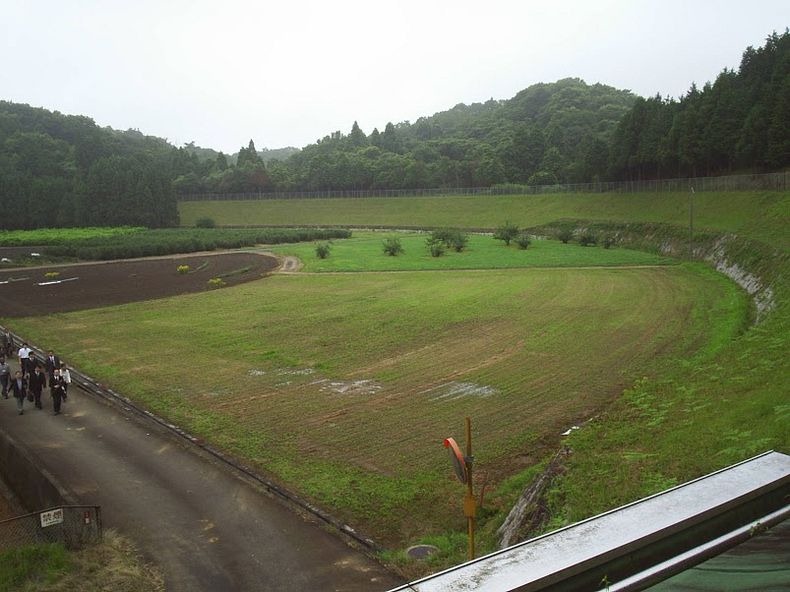
Modern genetic engineering has replaced the need for atomic gardening, but the legacy is still carried forward by the Institute of Radiation Breeding in Japan, which currently owns the largest, and possibly the only surviving gamma garden in the world, at Hitachiōmiya in Ibaraki Prefecture. The circular garden measures 100 meters in radius, and enclosed by an 8-meter high shielding dike wall. Species within are irradiated with gamma rays from a cobalt-60 source placed inside a central pole. The purpose here is to generate new traits such as tolerance to fungus infection or consumer-friendlier fruit colors, and in general, help meet demands for development of crop varieties with new traits.
Nanotechnologist Paige Johnson of the University of Tulsa, Oklahoma, who researches atomic garden history in her spare time, says: "If you think of genetic modification today as slicing the genome with a scalpel, in the 1960s they were hitting it with a hammer". Indeed, before scientist learned how to modify genes, they induced mutations with radiation and hoped for the best.
Paige describes about these gamma garden in an interview to Pruned, that is worth reading.
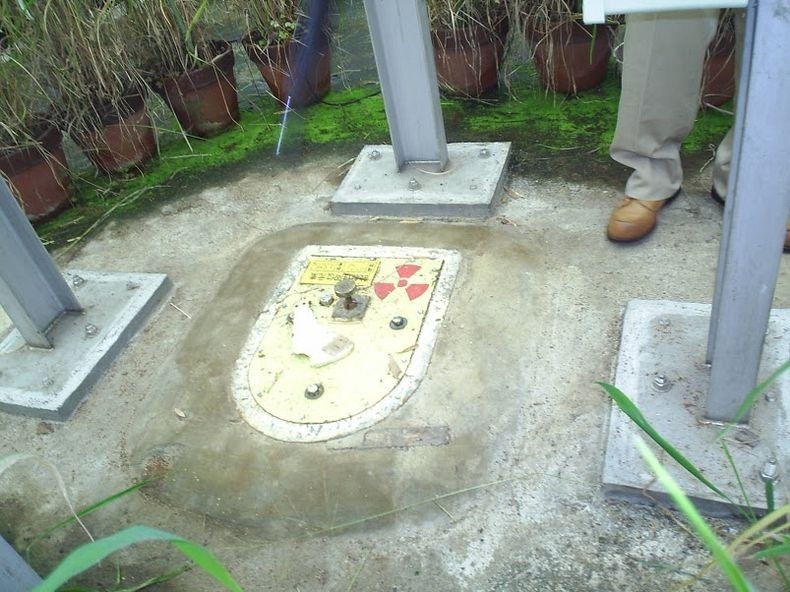
It was basically a slug of radioactive material within a pole; when workers needed to enter the field it was lowered below ground into a lead lined chamber. There were a series of fences and alarms to keep people from entering the field when the source was above ground.
The amount of radiation received by the plants naturally varied according to how close they were to the pole. So usually a single variety would be arranged as a 'wedge' leading away from the pole, so that the effects of a range of radiation levels could be evaluated. Most of the plants close to the pole simply died. A little further away, they would be so genetically altered that they were riddled with tumors and other growth abnormalities. It was generally the rows where the plants 'looked' normal, but still had genetic alterations, that were of the most interest, that were 'just right' as far as mutation breeding was concerned!
According to Dr. Lagoda, the head of plant breeding and genetics at the International Atomic Energy Agency, radiation breeding has produced thousands of useful mutants and a sizable fraction of the world’s crops, including varieties of rice, wheat, barley, pears, peas, cotton, peppermint, sunflowers, peanuts, grapefruit, sesame, bananas, cassava and sorghum.
gamma-garden-10
gamma-garden-8
gamma-garden-6
gamma-garden-1
gamma-garden-2
gamma-garden-3
gamma-garden-4
gamma-garden-5

Atomic Gardening: Breeding Plants With Gamma Radiation

Did you know that the peppermint flavor in your chewing gum and toothpaste, and the red-ruby grapefruit on your plate, is the result of mutation caused by deliberate irradiation? Apparently, after World War II, there was a concerted effort to find peaceful uses for atomic energy. One of the ideas was to bombard plants with radiation and produce lots of mutations, some of which, it was hoped, would lead to plants that were disease or cold-resistant or just had unusual colors. The experiments were mostly conducted in giant gamma gardens on the grounds of national laboratories in the US, Europe and countries of the former USSR, leading to untold numbers of new plant varieties. The disease resistant peppermint plant and the 'Rio Star' grapefruit, which accounts for 75% of the grapefruit production in Texas, were created in these atomic gardens.
gamma-garden
Modern genetic engineering has replaced the need for atomic gardening, but the legacy is still carried forward by the Institute of Radiation Breeding in Japan, which currently owns the largest, and possibly the only surviving gamma garden in the world, at Hitachiōmiya in Ibaraki Prefecture. The circular garden measures 100 meters in radius, and enclosed by an 8-meter high shielding dike wall. Species within are irradiated with gamma rays from a cobalt-60 source placed inside a central pole. The purpose here is to generate new traits such as tolerance to fungus infection or consumer-friendlier fruit colors, and in general, help meet demands for development of crop varieties with new traits.
Nanotechnologist Paige Johnson of the University of Tulsa, Oklahoma, who researches atomic garden history in her spare time, says: "If you think of genetic modification today as slicing the genome with a scalpel, in the 1960s they were hitting it with a hammer". Indeed, before scientist learned how to modify genes, they induced mutations with radiation and hoped for the best.
Paige describes about these gamma garden in an interview to Pruned, that is worth reading.
It was basically a slug of radioactive material within a pole; when workers needed to enter the field it was lowered below ground into a lead lined chamber. There were a series of fences and alarms to keep people from entering the field when the source was above ground.
The amount of radiation received by the plants naturally varied according to how close they were to the pole. So usually a single variety would be arranged as a 'wedge' leading away from the pole, so that the effects of a range of radiation levels could be evaluated. Most of the plants close to the pole simply died. A little further away, they would be so genetically altered that they were riddled with tumors and other growth abnormalities. It was generally the rows where the plants 'looked' normal, but still had genetic alterations, that were of the most interest, that were 'just right' as far as mutation breeding was concerned!
According to Dr. Lagoda, the head of plant breeding and genetics at the International Atomic Energy Agency, radiation breeding has produced thousands of useful mutants and a sizable fraction of the world’s crops, including varieties of rice, wheat, barley, pears, peas, cotton, peppermint, sunflowers, peanuts, grapefruit, sesame, bananas, cassava and sorghum.
gamma-garden-10
gamma-garden-8
gamma-garden-6
gamma-garden-1
gamma-garden-2
gamma-garden-3
gamma-garden-4
gamma-garden-5

Tuesday, March 5, 2013

PINEAPPLE BENEFITS

The pineapple is a member of the bromeliad family.
It is extremely rare that bromeliads produce edible fruit. The pineapple is
the only available edible bromeliad today.

It is a multiple fruit. One pineapple is actually made up of dozens of
individual floweret's that grow together to form the entire fruit. Each
scale on a pineapple is evidence of a separate flower.

Pineapples stop ripening the minute they are picked.
No special way of storing them will help ripen them further.
Color is relatively unimportant in determining ripeness.
Choose your pineapple by smell.If it smells fresh, tropical and
sweet, it will be a good fruit.

The more scales on the pineapple, the sweeter and juicier the taste.

After you cut off the top, you can plant it.
It should grow much like a sweet potato will.

This delicious fruit is not only sweet and tropical; it also offers many
benefits to our health. Pineapple is a remarkable fruit.

We find it enjoyable because of its lush, sweet and exotic flavor, but it
may also be one of the most healthful foods available today.
If we take a more detailed look at it, we will find that pineapple is
valuable for easing indigestion, arthritis or sinusitis.

The juice has an anthelmintic effect; it helps get rid of intestinal worms.

Let's look at how pineapple affects other conditions.

Pineapple is high in manganese, a mineral that is critical to development of
strong bones and connective tissue. A cup of fresh pineapple will give you
nearly 75% of the recommended daily amount.

It is particularly helpful to older adults, whose bones tend to become
brittle with age.

Bromelain, a proteolytic enzyme, is the key to pineapple's value.
Proteolytic means "breaks down protein", which is why pineapple is known to
be a digestive aid. It helps the body digest proteins more efficiently.

Bromelain is also considered an effective anti-inflammatory.

Regular ingestion of at least one half cup of fresh pineapple daily is
purported to relieve painful joints common to osteoarthritis. It also produces mild pain relief.

In Germany , bromelain is approved as a post-injury medication because it is
thought to reduce inflammation and swelling.

Orange juice is a popular liquid for those suffering from a cold because it
is high in Vitamin C. Fresh pineapple is not only high in this vitamin, but because of the Bromelain, it has the ability to reduce mucous in the throat.

If you have a cold with a productive cough, add pineapple to your diet.
It is commonly used in Europe as a post-operative measure to cut mucous
after certain sinus and throat operations.

Those individuals who eat fresh pineapple daily report fewer sinus problems
related to allergies. In and of itself, pineapple has a very low risk for allergies.

Pineapple is also known to discourage blood clot development. This makes
it a valuable dietary addition for frequent fliers and others who may be at risk for blood clots.

An old folk remedy for morning sickness is fresh pineapple juice.
it really works! Fresh juice and some nuts first thing in the morning often
make a difference.

Sunday, January 13, 2013

Twinkie Recipes

Super Easy Cake Mix Twinkie Recipe

Cake:
4 eggs
1/2 cup (1 stick) margarine or butter, melted and cooled to lukewarm
1 cup water
1 (5.1 ounce) package instant vanilla pudding mix
1 (18.25 ounce) package yellow cake mix
Filling:
1/2 cup (1 stick) margarine or butter, room temperature
1 (8 ounce) package cream cheese, or tofutti cream cheese room temperature
5 cups confectioners’ sugar, sifted
1 cup (8 ounce) whipping cream or non-dairy whipping cream,
1 teaspoon vanilla extract
Preheat an oven to 350 degrees. Grease and flour two 10×15 inch jelly roll pans.
Beat the eggs until combined; stir in the melted margarine or butter. Add the water, pudding mix, and yellow cake mix, stirring well to combine. The batter will be very thick. Divide the batter between the prepared pans, spreading it evenly.
Bake until the cakes spring back when pressed lightly with a finger or a tester comes out clean, 15 to 20 minutes. Cool completely on wire racks.
To make the filling, combine margarine or butter, cream cheese, and confectioners’ sugar. Beat until smooth. Stir in the whipped cream and vanilla extract.
When the cakes are cool, spread the filling mixture on top of one cake layer. Place the second cake layer on top of the first, and place in the freezer for 15 minutes (this will make the filling a little stiffer so they will stay intact while cutting). Take them out and cut into bars. Wrap each bar in plastic wrap and store in the freezer until ready to serve. Thaw for thirty minutes before serving.

Homemade Twinkies


This one is made with corn meal so it has a yellow color just like the original.
8 ounces (two sticks) unsalted butter (melted) or margarine
2 cups sugar
4 large eggs
2 ¾ cups all purpose flour
¼ corn meal
1 tablespoon baking powder
1 teaspoon baking soda
1 ½ teaspoon kosher salt
1 ¼ cups buttermilk (or 1 cup and 1 tablespoon non-dairy creamer PLUS 3 tablespoons white vinegar for pareve equivalent)
Whisk together butter, sugar, eggs and buttermilk. Fold in dry ingredients. Spoon into prepared moulds and bake at 350 for about 20 minutes. Once cool, trim the tops and inject filling.
If you made in muffin cups, either in just filling or scoop out some of the center of the muffin and fill with filling.
Filling
16 ounces cream cheese or tofutti cream cheese
1 cup powdered sugar
¼ cup whipping cream, whipped
1 vanilla bean scraped and pod discarded (optional, but tasty)
In a mixer, beat cream cheese until light and fluffy. Add in powdered sugar and mix on low speed so that it does not fly all over the kitchen. Fold in whipping cream and vanilla bean.